


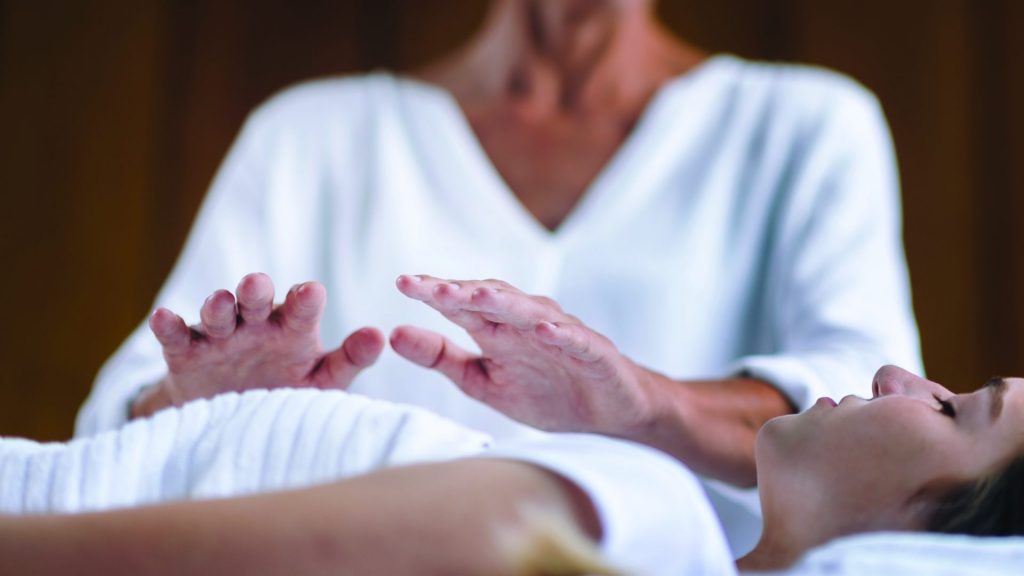
Reiki is a spiritual practice that promotes overall balance. It’s practiced through light, non-manipulative touch to someone who is fully clothed and lying down or seated in a comfortable chair. The beginning level, or First Degree, Reiki practice is both easy to learn and easy to practice on oneself.
Because Reiki practice is balancing to the receiver according to his/her current state, the experience of a session varies somewhat from person to person and session to session. People who receive repeat Reiki sessions will also find that each experience is somewhat different. That said, people receiving Reiki treatment typically experience some level of relaxation, reduced stress and pain, and an increased sense of well-being. After Reiki treatment, people commonly report feeling more centered, clear, and present; at ease in themselves. People experiencing difficult life challenges often feel more hopeful, confident in their ability to address those challenges effectively.
Reiki practice isn’t considered dangerous or harmful in any medical condition or setting because balance is always desirable, no substance is ingested and the touch is very light and completely non-manipulative. Additionally, Reiki can be practiced just off the body when even light touch is contraindicated, as in the case of burns. Reiki treatment will support, and never interfere with, other medical or healing interventions being used, and helps manage side effects of necessary, but invasive, medical treatments such as radiation, chemotherapy, or surgery.
The following unique characteristics of Reiki practice make it appropriate and easy to use in a wide range of circumstances:
- Reiki practice does not target symptoms or medical conditions directly in the way conventional medicine does; rather, it engages the body’s self-healing response.
- Reiki practice is easily learned at the entry level, or First Degree practice, by anyone who has the interest, including children, the elderly and people with chronic illnesses such as Parkinson’s disease, cancer or HIV/AIDS.
- Reiki is as effective in self-treatment as when treatment is received from another person, a friend, family member, or professional. That means families can learn to practice to support themselves and one another.
- Reiki self practice is effective regardless one’s physical or emotional health.
- No diagnosis is needed, nor does the receiver have to be ill to benefit.
- Reiki treatment is balancing to both recipient and practitioner.
- Reiki treatment can be offered simultaneously with any medical, complementary or alternative treatment; because it is balancing, Reiki treatment seems to lighten the distress caused by side effects of conventional treatment.
- Reiki practice is simple; it cannot be done incorrectly.
Benefits of Reiki Treatment
Through an as yet unknown mechanism, Reiki practice gently elicits a profound self-healing response within the receiver. Because it is so gentle, and can be offered without touch when needed, Reiki practice can be a helpful component of a comprehensive treatment plan even for people who have experienced trauma. Reiki practice can encourage balance on the deepest levels of being where the subtle underpinnings of disease are held. For that reason, it can be a useful addition when patients are not responding to the usual medical treatment.
In a study published in the American College of Cardiology, Reiki treatment improved heart rate variability (HRV) in patients who had had a heart attack in the past 72 hours. That improvement is critical because poor HRV is the most reliable predictor of death from a second heart attack. And improving HRV is valuable beyond cardiology because normal HRV indicates a system that is capable of self-healing. More research is needed.
Each person’s path of healing is unique, and the benefits that individuals attribute to their Reiki treatment are varied and numerous, but there are some benefits that are experienced more often than not. Besides the immediate feeling of profound relaxation, the following benefits are commonly reported:
- Improvements in sleep and digestion
- Effective pain management
- Lessened anxiety
- Greater ease in breathing
- Reduction of side effects of medications and invasive medical treatments Such as radiation or chemotherapy
- Clearer thinking
- Support in recovery from addictions
- Enhancement of self-esteem
- Greater self-acceptance and self-awareness
- Increased satisfaction in relationships
- Sense of spiritual connection that does not involve adherence to specific beliefs.