
 Roger Jahnke OMD
Traveling to China to study Taiji (T'ai Chi) and other
forms of Qigong (Ch'i Kung) is a transformative experience.

Traveling to China to study Taiji (T'ai Chi) and other
forms of Qigong (Ch'i Kung) is a transformative experience.
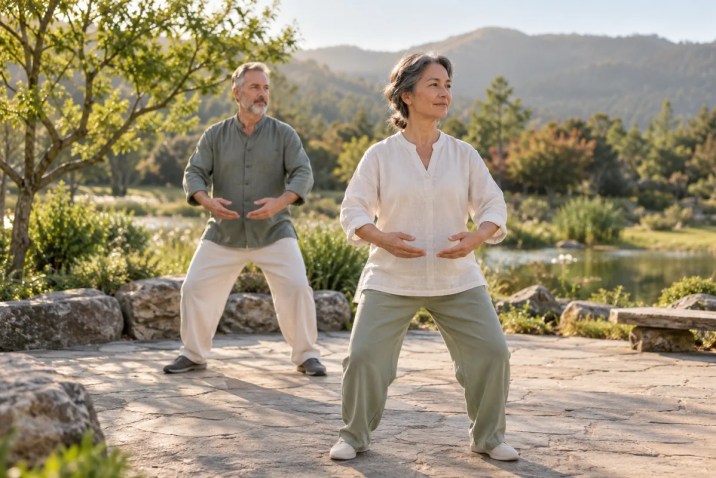
The history of Qigong (Ch'i Kung) commences beyond the era of written records, in the mists of prehistory. Earliest estimates suggest that self enhancement and empowerment practices date into the time of Chinese shamans, previous to 500 BCE. While...
"Master" is the word that all cultures use to describe someone who has attained high levels of skill. A Taiji (T'ai Chi ) master is generally one who has exceptional skill in doing the form or in using the Taiji principles in boxing(kung fu, martial...
The roots of Taiji (T'ai Chi) go deep into Chinese history. Taiji was originally a martial arts practice called Taijiquan (T'ai Chi Chuan). Quan (Chuan) means fist or boxing. The art has a legendary beginning in the philosophy of Daoism (Taoism)...
In China it is typical for people to practice Qigong (Ch'i Kung) or Taiji (T'ai Chi) for about an hour between 5:30 am and 6:30 or from 6 am to 7 am. Frequently they practice in large groups. It is not unusual to see a group of people doing Taiji...
If you have wondered whether Qigong and Ch'i Kung and
Chi Gung are all the same thing, you are not alone. If you
h
In the practice of all forms of Qigong, including the
various styles of Taiji, there are a few guidelines that
will
In the 1600's the social, scientific and philosophical history of western culture experienced a radical shift. The work of Newton and Galileo literally revised our world. For thousands of years the humans were locked in the stagnation of the dark...
Choosing Your Path ;Self healing, self care, self initiated healing,
Qigong practice activates a number of the body's self regulating systems which are responsible for the balanced function of the tissues, organs and glands. The uptake of oxygen, as well as, oxygen metabolism is tremendously enhanced by Qigong...

